
In partnership with

The Bottom Line Upfront 💡
$META ( ▲ 1.9% ) Meta runs one of the most profitable advertising engines ever built, and revenue is compounding at 30%. But at ~$590, you are paying for the bull case: a traditional DCF says the good news is mostly priced in. This is a "show me" moment for the $130-145B AI capex story.
Sponsorship
Find Out What's Holding Your Revenue Back

Your business didn't plateau overnight. Growth slowed one bottleneck at a time.
But more hours at the office, more hires, and more marketing won't remove a hidden limitation. They just make it harder to spot.
The Revenue Ceiling Report reveals the four most common growth ceilings so you can identify what's quietly costing your business revenue and what to do next.
BELAY’s U.S.-based Assistants help build the systems and support that turn sustainable growth into reality.
Strata Layers Chart
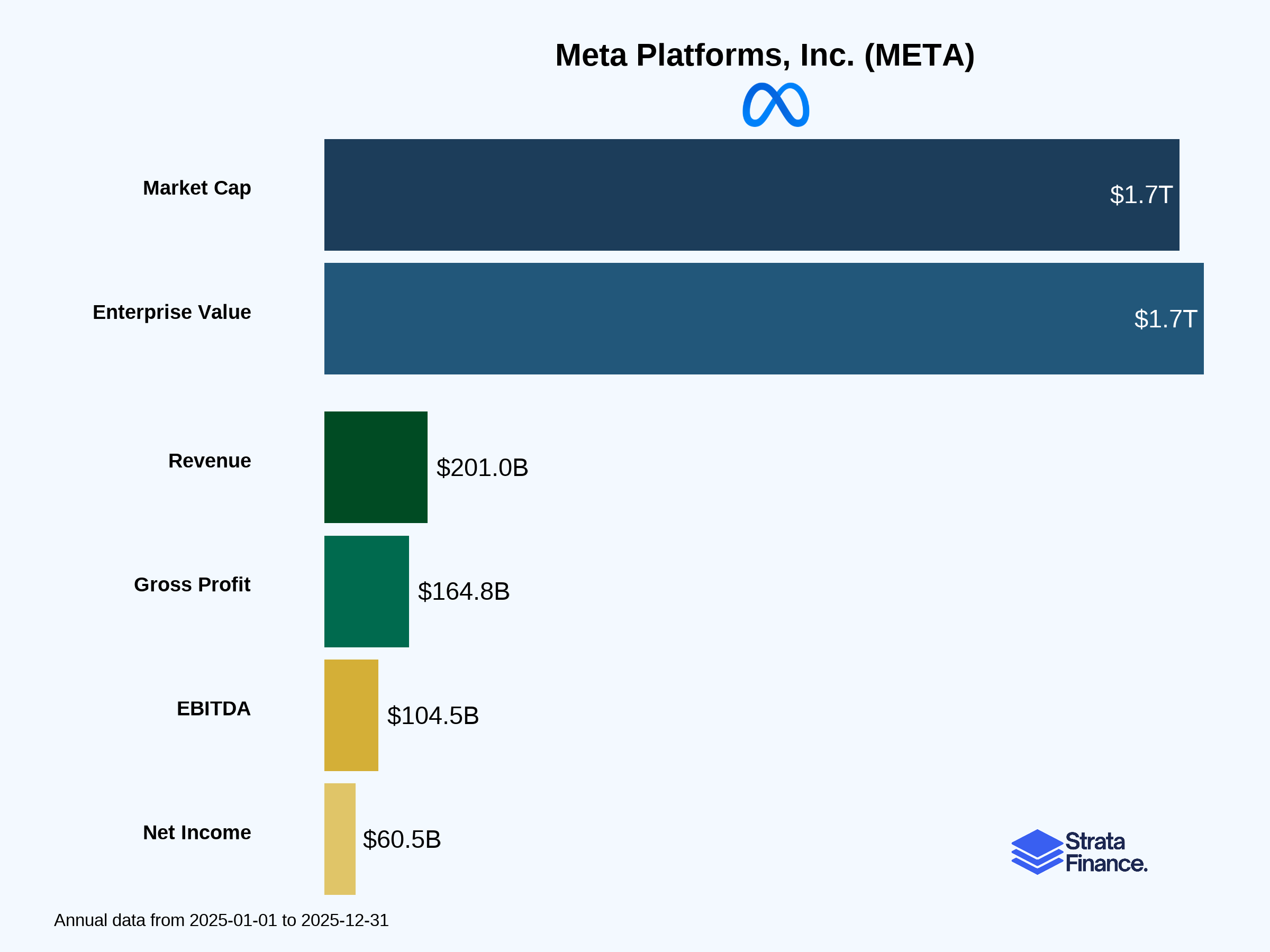
Layer 1: The Business Model 🏛️
Meta owns the world's most-used social apps: Facebook, Instagram, WhatsApp, and Messenger. Think of it as owning every major town square on Earth and charging businesses to put up billboards. That is essentially the model: 3.6 billion people show up daily, and advertisers pay handsomely to reach them.
How it makes money:
Advertising (97%+ of revenue): Marketers pay per impression or per action (click, purchase, etc.). Meta's AI matches the right ad to the right eyeball at the right moment.
Other FoA revenue: WhatsApp paid messaging, Meta Verified subscriptions, and developer fees. Growing fast (+73% YoY) but still tiny.
Reality Labs: Meta Quest headsets and Ray-Ban AI glasses. Cool hardware, brutal losses ($8.6B operating loss in H1 2026 alone).
Key metrics Meta obsesses over:
DAP (Daily Active People): 3.60B as of June 2026 ↗️. More people means more ad inventory.
ARPP (Average Revenue Per Person): $16.86 in Q2 2026 ↗️ (+24% YoY). More revenue per eyeball means better monetization.
Ad Impressions: +14% YoY ↗️. More ads shown.
Average Price Per Ad: +12% YoY ↗️. Advertisers paying more per ad.
Both volume AND price are rising simultaneously. That is a very good thing.
Key Takeaway: Meta is an advertising machine powered by the largest captive audience in human history, with AI making those ads increasingly effective.
Layer 2: Category Position 🏆
Meta and Google together control roughly 60% of global digital advertising. Everyone else is fighting for scraps. TikTok is the most credible threat (especially with younger users), which is why Meta cloned it with Reels. Snapchat, X (formerly Twitter), and Pinterest are competitors in the loosest sense of the word.
Where Meta is winning:
AI-powered ad targeting is recovering ground lost after Apple's 2021 iOS privacy changes ↗️
Reels engagement is surging, pulling users back from TikTok
WhatsApp monetization is just getting started (2B+ users, barely monetized)
The FTC antitrust case (seeking to force divestiture of Instagram and WhatsApp) was won by Meta in November 2025. The FTC appealed, but Meta cleared the biggest legal hurdle it faced.
Where it is getting squeezed:
Europe is a regulatory minefield: GDPR fines, Digital Markets Act battles, Digital Services Act investigations, and a €798M Facebook Marketplace fine. The EU basically has a standing desk dedicated to suing Meta.
Youth-related litigation is exploding: 29 state attorneys general, school districts, and over 200,000 individual arbitration demands alleging social media addiction harms.
Key Takeaway: Meta's competitive moat is enormous, but regulatory friction in Europe and legal exposure from youth-harm litigation are real, ongoing costs of doing business.
Layer 3: Show Me The Money! 📈
Revenue breakdown (H1 2026):
Source | Revenue | Growth |
|---|---|---|
Advertising | $114.4B | +30% ↗️ |
Other (FoA) | $1.9B | +73% ↗️ |
Reality Labs | $833M | +7% ↗️ |
By geography (H1 2026):
US & Canada: $45.1B (+28%) ↗️, highest revenue per user
Europe: $27.2B (+31%) ↗️, regulatory headwinds but still growing
Asia-Pacific: $31.5B (+31%) ↗️, massive volume, lower per-user revenue
Rest of World: $13.2B (+37%) ↗️, fastest growing, lowest monetization
The gap between US ARPP (~$68/quarter) and Asia-Pacific (~$13/quarter) is enormous. Closing that gap even partially is a multi-year growth engine.
The cost story (where it gets spicy): Meta is spending like it is building a second internet. R&D jumped 57% YoY in H1 2026, driven by AI infrastructure, third-party AI token costs, and a May 2026 layoff of ~8,000 employees (yes, severance costs spike expenses even when you are cutting headcount). Capital expenditure guidance for full-year 2026: $130-145 billion. That is not a typo.
Operating margin compressed to 31% in Q2 2026 (from 43% a year ago), largely due to $2.4B in legal charges and the severance hit. The six-month operating margin of 36% is more representative.
Key Takeaway: Revenue is growing 30% while costs are growing 46%, which is the right trade-off only if the AI infrastructure investment pays off. That is the central bet.
Layer 4: Long-Term Valuation (DCF Model) 💰
The Verdict: Fairly Valued to Moderately Overvalued
Scenario | Fair Value | vs Current Price (~$590) |
|---|---|---|
Bear Case (12% WACC) | ~$251 | -57% |
Base Case (10.6% WACC) | ~$404 | -32% |
Bull Case (8.5% WACC) | ~$724 | +23% |
FMP Estimate | ~$576 | -2% |
Key assumptions driving the range:
The terminal value dominates the DCF. A 2% change in WACC nearly doubles the output, which is why the range is so wide.
Bull case requires AI capex to generate measurable ARPU lift and WhatsApp monetization to accelerate meaningfully.
Bear case assumes regulatory fragmentation and AI spending that never converts to revenue.
One-line take: At ~$590, you are paying for the bull case. The stock is not obviously cheap.
Layer 5: What Do We Have to Believe? 📚
Bull Case 🚀
AI-powered advertising (Advantage+ suite) continues driving higher ROAS for advertisers, justifying the $130-145B capex splurge and expanding ARPP well beyond current levels.
WhatsApp Business monetization finally scales: 2B+ users with click-to-message ads growing 80%+ YoY is a sleeping giant.
Reality Labs losses plateau and eventually shrink as AI glasses (not just Quest headsets) find a mainstream consumer market.
Bear Case 🐻
The AI infrastructure buildout ($349B in non-cancelable commitments as of June 2026) delivers diminishing returns, and operating margins stay compressed for years.
European regulatory pressure forces meaningful changes to Meta's ad targeting model, structurally impairing European revenue (currently 23% of total).
Youth-harm litigation results in landmark settlements or injunctive relief that forces costly product changes across all platforms.
The Bottom Line: Meta is a genuinely exceptional business running one of the most profitable advertising engines ever built. The question is not whether it is a good company. The question is whether ~$590 per share already prices in the good news. Based on a traditional DCF, the answer leans toward yes, unless you believe the AI investment cycle will deliver returns faster and larger than the base case assumes. This is a "show me" moment for the capex story.
Layer 6: What to Watch 👀
ARPP trajectory: If worldwide ARPP keeps growing above 20% YoY, the AI ad-targeting thesis is working. A deceleration below 10% would be a yellow flag.
Operating margin recovery: Watch for margin to recover back toward 40%+ as severance costs fade and AI infrastructure depreciation stabilizes. If margins stay below 35% into 2027, the cost story is worse than expected.
Reality Labs losses: Management guided full-year 2026 RL losses to be "similar to 2025" (roughly $17-18B). Any meaningful improvement would be a positive surprise. Any acceleration in losses would be a problem.
Legal outcomes: The New Mexico AG case (seeking up to $62.85B in penalties), the ongoing FTC consent order battle, and the wave of youth-harm state AG trials in H2 2026 could each move the stock materially.
AI glasses traction: RL revenue growth in Q2 2026 was driven by AI glasses, not Quest headsets. If Ray-Ban Meta AI glasses become a genuine consumer hit, it changes the Reality Labs narrative entirely.
AI-written, human-approved
Disclaimer: This guide is for informational purposes only and does not constitute financial advice, investment recommendations, or an offer or solicitation to buy or sell any securities. The information contained in this report has been obtained from sources believed to be reliable, but StrataFinance does not guarantee its accuracy, completeness, or timeliness.